Reporting Flake
A powerful feature in the Happo review process is the ability to report a diff as flaky. To use this feature, choose "Report flake" from the "…" overflow menu next to any diff, or click the "Report flake" button (an exclamation mark in a circle) right next to that menu. Once reported, the menu option changes to "Not flake" so you can undo it.
Reporting a diff as flaky will instruct Happo to ignore that specific diff now and in the future. It should be used with a little bit of caution as it might hide issues that should be caught.
If your account only lets selected users review, only those reviewers can report a diff as flaky or undo a report, since an ignored diff can approve a comparison.
Examples of where it is okay to report a diff as flaky:
- ✅ When there's a diff that you can't attribute to the changes made.
- ✅ When there are flaky rendering-related issues not caused by your code.
Examples of where you should avoid reporting a diff as flaky:
- ❌ You've made a UI update causing diffs (simply accept the report instead).
- ❌ You believe the diffs are caused by a bug in Happo (reach out to us instead).
If the underlying cause of the flake is not addressed, similar flaky diffs will eventually return once the baseline changes. After reporting flake, it is good practice to follow up with a deeper fix.
Global effect
Diffs reported as flaky apply to all future and past Happo reports. You may still need to manually approve or reject.
Technical details
What a diff is
A diff is a visual difference Happo found between the baseline and the new run for a specific snapshot—for example, "Button / default / Chrome". Happo compares the two rendered images using your project's deep-compare thresholds (compareThreshold and ignoreThreshold, and any other compare settings you've configured). If the difference is above that threshold, it's shown as a diff. Each diff corresponds to one component, variant, and target combination.
How Happo identifies snapshots
Happo identifies each snapshot by what it is: component name, variant, target (browser/viewport), and a hash of the image data. When you report a diff as flake, Happo remembers that specific before/after pair. So the same flake is ignored everywhere it appears--in past, current, and future comparisons--as long as it's the same baseline and new snapshot. If your baseline or your rendered output changes later, Happo may show a new diff for that same component/variant/target, and that new diff won't be covered by the flake you reported earlier.
What happens when you report a diff as flake
When you click Report flake:
-
On the comparison page
That diff is moved out of the list of diffs (in this comparison and in any other comparison where the same snapshot pair appears), so you may see fewer diffs, or none. You can still find it under Ignored diffs in the sidebar, along with who reported it and when.
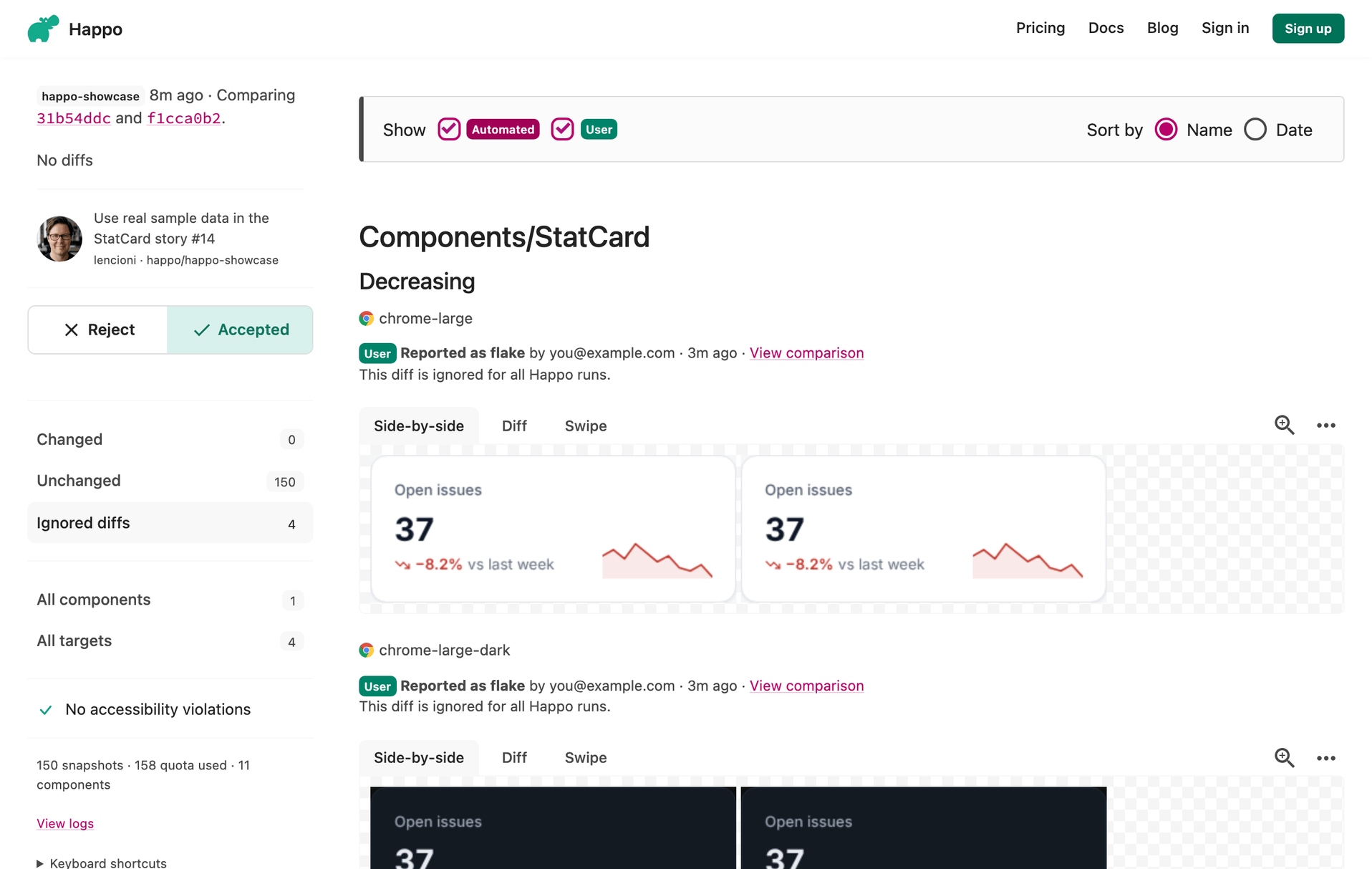
Each ignored diff says who ignored it: User for a flake a person reported on the comparison page, API for one reported through the API, MCP for one reported through Happo's MCP server, and Automated for one Happo ignored itself, most often because the project's deep-compare thresholds (
compareThresholdandignoreThreshold) let the diff through. Flakes reported before this was recorded show as User. You can show any of these on their own: with the checkboxes above the list, or, on the new comparison page, by typingignored:user,ignored:api,ignored:mcporignored:automatedin the filter box. API responses carry the same information in the ignored diff'signoredByfield. -
Build status
Your CI build status (e.g. the GitHub check) for that comparison is updated automatically if there are no longer any diffs remaining in the comparison.
-
Why flake can seem to come back
Because flake is tied to that exact before/after pair, a new run that produces a different snapshot (e.g. after a baseline update or a change in rendering) can show a new diff that isn't covered by the flake you reported. Fixing the underlying cause of the flake is the only way to prevent it from reappearing over time.